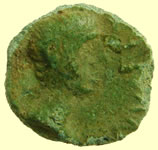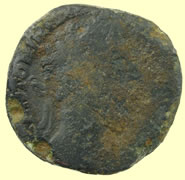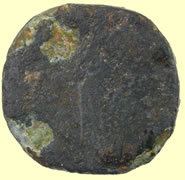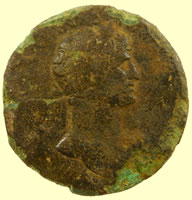
Metal detecting holidays in England with the World's most successful metal detecting club.
Twinned with Midwest Historical Research Society USA
Roman Bronze coins 1st to 2ndC
|
Other Roman coin links For 3rd to 4thC Roman bronze coins click here All comments and ID's under the coins are from Mark Lehman our clubs Roman coin expert
|
  |
|
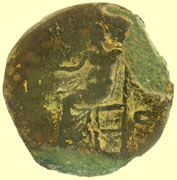
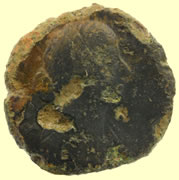
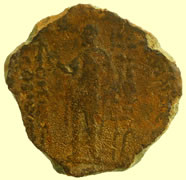
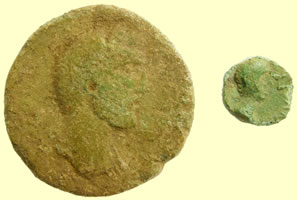
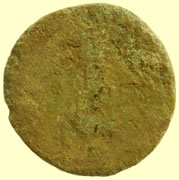
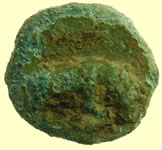
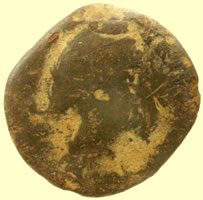
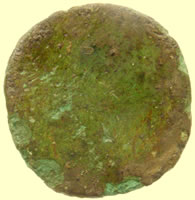
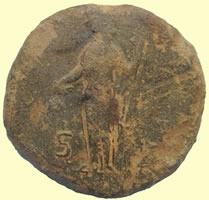
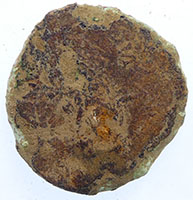
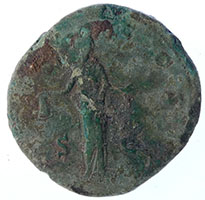
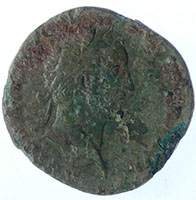
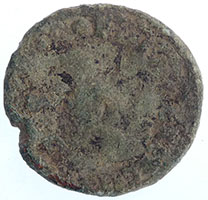
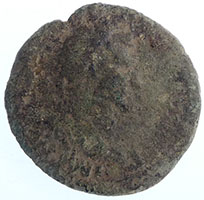
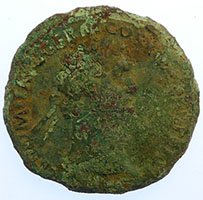
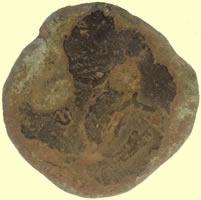
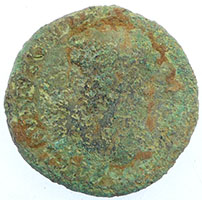
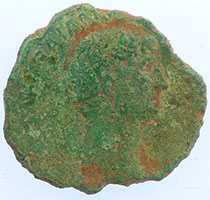
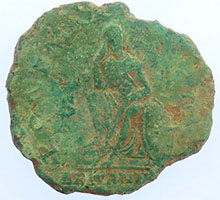
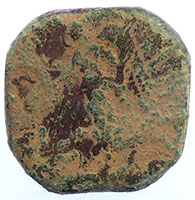
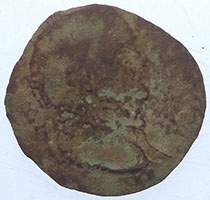
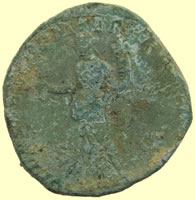
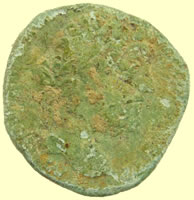
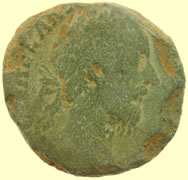
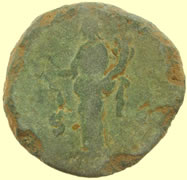
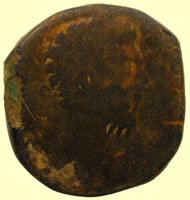
2ndC Roman bronze coin sent for ID 16.36g, 27.34mm The sestertius is either Antoninus Pius or Marcus Aurelius as Caesar (during the reign of Antoninus Pius). Their portraits are just too similar during that period - 139-161 AD - to be able to tell them apart in this photo - there's simply not enough contrast even to be able to tweak-up some bits of legend to try to tell them apart. The reverse is probably Liberalitas - they did a number of donatives to the public and so the Liberalitas reverses are pretty common. Probabaly no other 20-yr period saw the striking of more types of sestertii, so pinning this one down any closer without being able to read any legend is just not likely to happen. If you can take a photo in oblique light that allows some shadows to point-up what relief may be visible - or if it cleans up to be more legible, send me more photos and I'll see if I can pin it down more closely for you.
Mark
|
|
  |
|
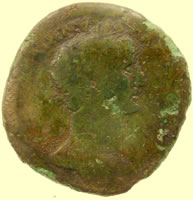
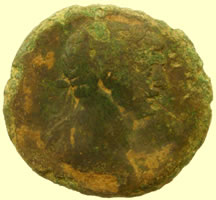
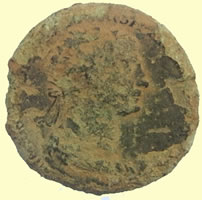
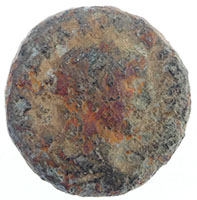
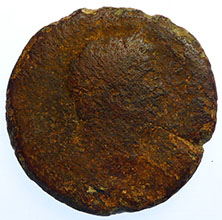
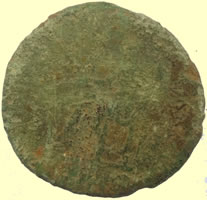
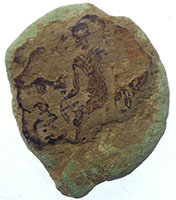
Big Roman AS coin - sent for ID There's not quite enough legend present to give you "chapter and verse" on this one, but it's Marcus Aurelius - 161-180 AD - and the reverse type is Aequitas holding a set of scales and cornucopiae. Chances are the reverse legend is a typical Antonine laundry-list of titles, TR P, IMP and COS year notations. Mark |
|
  |
|
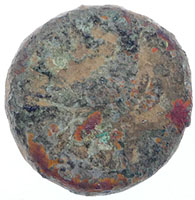
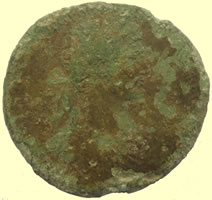
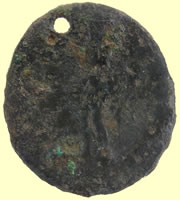
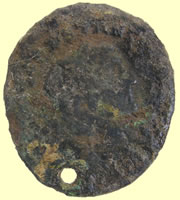
4thC Roman coin used as Saxon pendant - sent for ID 6.84g,28.86mm Although I can't make out very much of the name on the obverse, on the basis of size and general type plus what few letters are readable, I'll guess that this is Constantius I (father of Constantine the Great) as Caesar - 293-305 AD. He is particularly associated with Britain, BTW, dying at York in 306 after a very brief stint as Augustus. The reverse appears to be the common GENIO POPVLI ROMANI type with the "Genius" of the Roman People standing left, sacrificing from a patera and holding a cornucopiae. This was the more-or-less "standard" reverse type for the large-module folles of the late 3rd-early 4th centuries - although there were many other types, the "Genio's" far outnumbered any other type and were struck at all Imperial mints. Mark |
|
  |
|
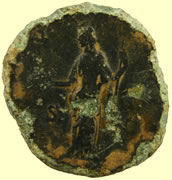
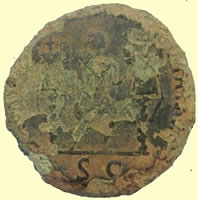
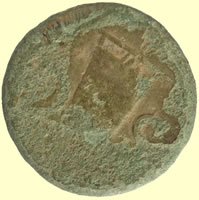
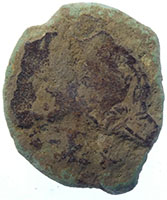
Huge As sized Roman bronze coin - sent for ID That is definitely Marcus Aurelius - 161-180 AD. The piece is a little too worn to get an accurate date from it - the reverse type is reduced to "generic" personification: female, facing left, raising right hand and/or holding something in it, and either resting on a scepter or holding a cornucopiae, etc. Could be any of 20 or 30 stock personifications of abstract concepts.
If there were enough detail left in the obverse legend for it to be deciphered, it would probably contain a TR P or Consular date which would allow us to narrow-down the time-frame to a year or two, but that is an "older" bust of Aurelius, when he had let his "Philosopher's Beard" grow, and was being portrayed on coins with it long and scraggly.
My guess is that it's no earlier than 170 AD - and could be as late as 180.
Mark
|
|
  |
|
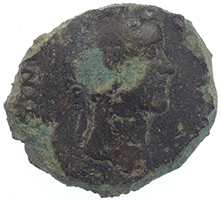
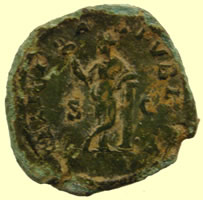
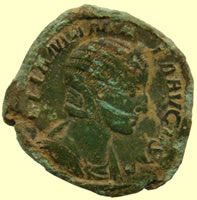
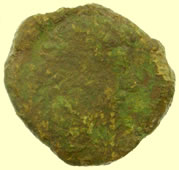
3ndC Roman coin sent for ID 23.36g, 34mm he "As" (depending on size, it might be a sestertius) is Julia Mamaea, mother of Severus Alexander, 222-235 AD. (and the real power behind the throne). The reverse type is FELICITAS PVBLICA with Felicitas cross-leggedly lounging against a conveniently located short column, holding a caduceus. It's known in at least 2 different sizes - Sestertius and Dupondius/As. Since the bust is not on a crescent, we can rule out Dupondius, so depending on size, it's either an As or a Sestertius. This type dates to 228 AD. Here's a photo of a Sestertius of the same type in my collection - http://www.stoa.org/gallery/album97/ML_20_J_Mammaea_Felicitas_sest Mark |
|
  |
|
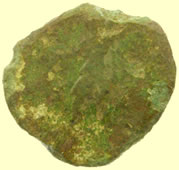
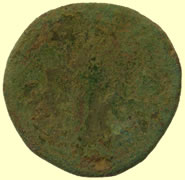
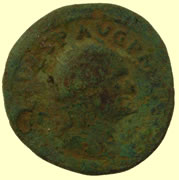
2ndC Roman bronze coin sent for ID The 1st one here is (I'm almost completely sure) a Marcus Aurelius with winged thunderbolt reverse. These typically date to fairly late in his career as Augustus - the late 170's AD. But I'm not sure what the denomination is. I couldn't quickly find an example of an As with the winged thunderbolt reverse, only a Dupondius. However, it doesn't appear that Aurelius is wearing the radiate crow of Helios/Sol - and all his Dupondii are radiate - so I'm a little uncertain about the denomination, but it surely is Marcus Aurelius and a winged thunderbolt reverse. Mark |
|
  |
|
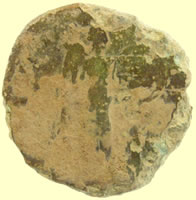
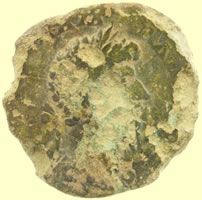
Roman coin sent for ID |
|
  |
|
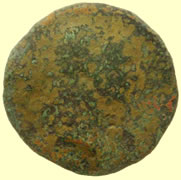
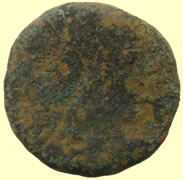
Huge Roman As sent for ID It's probably best - or at least easiest - to identify this piece for you this way, see: http://www.stoa.org/gallery/album94/ML07_M_Aurel_Vic_Writing_sest
Since their portraits are so similar, and the legends are as well, since the legends are almost gone on your specimen, it could be either Aurelius or Verus. On the basis of general scarcity, I'd say it's more likely to be Marcus Aurelius, but the portrait favors co-emperor Lucius Verus. In either case, this type - Victory hanging a shield inscribed VIC / PAR on a palm tree - dates to 166 AD.
Mark
|
|
  |
|
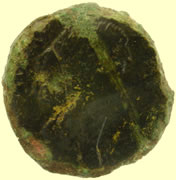
Huge 134 AD Hadrian Roman As coin |
|
 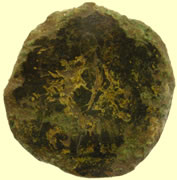 |
|
Huge 134 AD Hadrian Roman As coin |
|
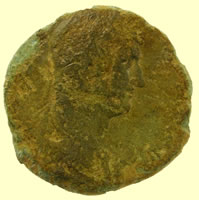 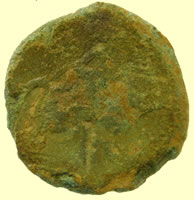 |
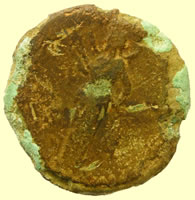 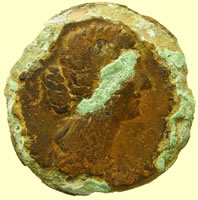 |
Large Roman 1st/2ndC AS sent for ID
These are AE's of Faustina II, wife of Marcus Aurelius (I believe - it could be Lucilla, but she's not as likely as Faustina) and Hadrian. I can't quite figure out what's happening on the reverse of the Hadrian - looks like a transverse chain? Nothing I'm immediately familiar with, at any rate. perhaps it is 45º rotated to clockwise and I'm seeing a shield and the outline of drapery and an arm? If so, could be a lot of different things, but Roma, Mars & Virtus come to mind - all would have grounded shields.
The Faustina/Lucilla Rx is a Diana Lucifera type - Diana holding a long torch transversely.
Mark
|
Large Roman 1st/2ndC AS sent for ID These are AE's of Faustina II, wife of Marcus Aurelius (I believe - it could be Lucilla, but she's not as likely as Faustina) and Hadrian. I can't quite figure out what's happening on the reverse of the Hadrian - looks like a transverse chain? Nothing I'm immediately familiar with, at any rate. perhaps it is 45º rotated to clockwise and I'm seeing a shield and the outline of drapery and an arm? If so, could be a lot of different things, but Roma, Mars & Virtus come to mind - all would have grounded shields.
The Faustina/Lucilla Rx is a Diana Lucifera type - Diana holding a long torch transversely.
Mark
|
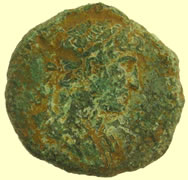 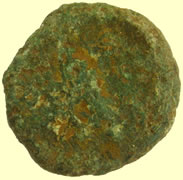
|
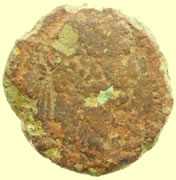
|
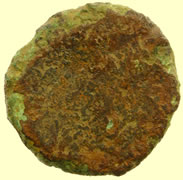
2nd C Roman bronze sent for ID |
Non hoard Roman bronze sent for ID 29.76mm, 16.03g This one will be from a different occupation horizon that most of what you've been digging recently. It's not easy to be sure with the condition it's in, but I believe that's a mature-bust portrait of Hadrian - so we're looking at c. 125-138 AD. 200 years, give or take, before the Constantinian-era material which has been the majority of what you seem to be finding at your "village" site.
It's interesting, overall, that you almost never seem to find any 3rd century / Severan Dynasty material - on this or any of your other sites. It's as though the area was abandoned for a century-plus between the late 2nd century and the early-mid 4th century.
Mark
|
Non hoard Roman coin sent for ID Quick reply is that it's a sestertius of Marcus Aurelius as Caesar (138-161) under Antoninus Pius. Not sure what the reverse type is yet, the figure is in "military garb" but I don't recognize the pose right offhand - I'll look more closely later.
Mark
I spent a good deal of time trying to run this one to ground - and didn't quite satisfy myself as to who, what and when it is, but I can tell you generally what it has to be. On the basis of the un-bearded-looking chin, in order of likelihood, this is a sestertius of A) Antoninus Pius, B) Marcus Aurelius, C) Commodus. Although all three tended to sport beards, all three began with either very tightly cropped beards or bare chins - Antoninus, however, kept his beard short and trim throughout his reign. All three used legends at some point in which ANTONINVS appears early in the obverse legend - Antoninus througout his reign. M. Aurelius as Caesar (ie: short beard) seldom, but as Augustus, nearly always (but always with a long, pointy or even scraggly-looking "Philosopher's beard" as Augustus.) Commodus, whether early or late in his reign, very seldom, but not "never".
So, as you can see the indicators point towards Antoninus Pius (although I believed it was M. Aurelius Caesar or even Commodus from the portrait) for the obverse.
The reverse has a figure dressed in "Military garb" standing, either left or facing. presumably holding something in that upraised hand and perhaps cradling a short object in the left elbow. Figures of Virtus / Roma in military garb abound for all three - here's an example of a Virtus reverse for M. Aurelius as Caesar - http://www.stoa.org/gallery/album94/M_Aurel_Caes_Virtvs_Sest1 - Virtus is not in the same pose, but dressed similarly and holding a short(ish) object, the parazonium, in the crook of the arm (albeit, the right arm). There is also a type common to all 3 of "The Emperor in military garb standing..." but usually with easily identified attributes - Spears, Standards, Leaning on Shields, etc.
After going through RIC III page-by-page for the whole Antonine Dynasty, I did not satisfy myself that I had found "The Type" beyond question, but there were many examples for which the ambiguous bits of legend and/or types on this coin could be made to fit. More for Antoninus than for the other suspects. So, in the interest of getting something else done today, I'm going to cut my losses and say "Probably Antoninus Pius and probably Virtus/Roma on the reverse" This places us somewhere between about 140-160 AD. - but those are the same years as for M. Aurelius as Caesar, and M. Aurelius Augustus shared the purple with his son Commodus from about 175-180, but Commodus was also Caesar from 166-176 (and would have had a bare or barely bearded chin), so you can see there's a LOT of potential overlap of era here.
Basically, it's really too bad that there isn't more clear legend on the obverse and/or in addition to the S-C on the reverse.
Mark
Mass Gary's hoard coins
|
|
1stC Roman bronzes with detail sent off for ID Sestertius of Commodus, son of Marcus Aurelius, (177-192) 16.21g, 29.88 - As or Dupondius of Faustina II, wife of Marcus Aurelius, 12.85g, 27.76mm
|
|
The larger of the two is Faustina the Elder - wife of Antoninus Pius. She did her duty as a Roman matron and popped-out a lot of Imperial larvae, then (conveniently for him, it would seem - although we have no evidence of him taking any advantage of his most-eligible-bachelor status) she died in 141 AD, only 3 years after Antoninus donned the purple. Among her daughters was Faustina the Younger, wife of Antoninus' successor, Marcus Aurelius. This coin was part of the relatively huge posthumous coinage Antoninus minted in her honor throughout his long reign (138-161). The reverse shows Juno standing left, holding a patera and resting on a scepter.
The smaller piece, an As it would appear, is Antoninus Pius - other than what I think is a pair of legs - indicating a standing character of some sort - I'm afraid I can't make sense of the reverse from the photo - if it is cleaned any further, or you can get a photo which makes whatever detail there may be seem more clearly visible, I can give you at least a guess as to what the reverse type might be.
Mark
Antoninus Pius (138-161 AD) AE As, 26mm, 10.50gm, BRITANNIA COS III; SC (in ex). Britannia seated left on rock in attitude of dejection, chin propped on right hand and left hand resting on rock; in background, shield and vexillum. RIC II 934, SR 4296, VM 119.
These are not "rare", or even really scarce, but they tend to sell for much more than comparable contemporary pieces due to the Britannia reverse. This design was struck on all of Antoninus' AE denominations and the sestertii can be quite pricey - particularly if they're in nice condition.
There is also a Britannia reverse from Hadrian's "grand tour" series, but those are rare - and very expensive.
I'll get back to you when I've had a chance to analyze the photos you attached to today's mail.
Mark Antoninus Pius (138-161 AD) AE As, 26mm, 10.50gm, BRITANNIA COS III; SC (in ex). Britannia seated left on rock in attitude of dejection, chin propped on right hand and left hand resting on rock; in background, shield and vexillum. RIC II 934, SR 4296, VM 119. These are not "rare", or even really scarce, but they tend to sell for much more than comparable contemporary pieces due to the Britannia reverse. This design was struck on all of Antoninus' AE denominations and the sestertii can be quite pricey - particularly if they're in nice condition.
There is also a Britannia reverse from Hadrian's "grand tour" series, but those are rare - and very expensive.
I'll get back to you when I've had a chance to analyze the photos you attached to today's mail.
Mark
|
|
Interesting group, but I'm afraid what they indicate is at very least a couple centuries occupation.
I'm thankful you're asking for guesses at this point - very little here I am feeling completely confident attributing to specific folks, but the general time-frames are not in question. I will try to fill-in details over the next couple days (I'm recovering from the flu and not spending as much time at my desk as I normally do.)
The one you describe as "Celtic" is most likely Spanish - "Romano-Celitberian" as they call them - segueing into Provincial issues - and is a "DIVVS" (deified) someone from the clear bit of counter-clockwise legend around 4:00-5:00. I'm guessing Augustus but it could be Julius, Agrippa, etc. Not earlier than late 1st century BC (c. 40 BC at the earliest) and not likely to be later than 25-35 or so AD when the Spanish Provincials dried up in favor of Imperial coin.
The one with the apparently severly advanced bronze disease pits in the obverse I can tell you is a "Caesar" - as in "crown prince", "emperor in training", "heir apparent", etc. The reverse type is PRINCIPI IVVENTVTIS - or some variant of the same - "Prince of Youth". I don't know, off the top of my head, which Caesar was portrayed with 4 standards and holding a scepter (that's unusual - typically it's only 1 or 2 standards, but this should work to our advantage, eventually), but I'm sure I can figure it out. It's unlikely to be earlier than Commodus (c. 160's) or later than Herrenius Etruscus (c. 250) If I read your metrics correctly, that one's an As
The one in the middle, of approximate sestertius weight with the gorgeous portrait, seems not to be Roman Imperial - at first glance, it seems to be Provincial, but since so far I can't read a single letter on obverse or reverse - I'd have to guess that one was supposed to be Caracalla, Geta, Philip II, or another of the baby-faced but bearded 3rd century folks. - Again, gussing only, c. 200-245 AD. The portrait style is just not correct for Roman Imperial of the era.
Mark
|
|
Huge 2ndC Roman sent off for ID 28.21mm dia x 4.58 mm thick 19.14g This is a sestertius of Marcus Aurelius - 161-180 AD. I don't think I can tell you a lot more on the basis of what I can see here. The reverse shows one of literally dozens of standing female allegorical personifications or minor deities Aurelius used on his coins over the course of 2 decades as Augustus (of course, he had already had 2 decades of extensive coinage before this as Caesar under Antoninus Pius). There aren't any obvious clues as to which it might be. That, and the 2nd half of the obverse legend being missing or illegible means I can't date it more closely than to say this dates to his time as emperor, 1st part of the 2nd half of the 2nd century AD..
Mark
|
|
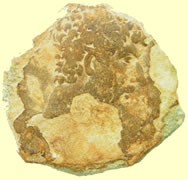
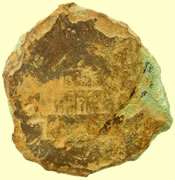
Roman 2nd bronze coin 32.93mm, 21.49g
is a sestertius of Hadrian - and a very young portrait style, too - his portrait still resembles Trajan at this point and he's shown with a very long neck and bare chest - probably about 117-120 AD, but without a clue about the reverse I can't be any more specific. Mark
|
|
|
|
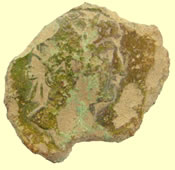
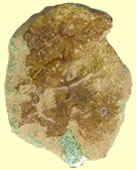
1st C Roman bronze sent for ID That is indeed a sestertius - or what's left of one - and was issued posthumously in honor of Lucius Verus - co-emperor with Marcus Aurelius from 161 AD to his death in 169. He wasn't much help while he was alive, being more interested in the "percs" and pleasures of Imperium than in service like his senior partner Marcus Aurelius, who spent nearly his whole reign out on the borders fighting "barbarian" invaders. He was "family", however - the son of Hadrian's chosen heir Aelius who predeceased him (Hadrian), and was married to Marcus Aurelius' daughter Lucilla - so was accorded all the conventional honors, etc.
The "wedding cake" looking arrangement on the reverse is a huge funeral pyre. The Romans cremated their dead, mostly, and the more important a person, the more public and lavish the event. Those who had no real "name" but were rich, might arrange for extravagant funerals as well, to try to gain some fame after death, at least.
There were two "stock" posthumous reverses for emperors at this time, the "layer-cake" crematory pile and an eagle standing on a globe. This coin was issued by Marcus Aurelius right after Verus' death in 169 AD. Similar coins were issued for both Antoninus Pius and Marcus Aurelius after their deaths - Verus' posthumous coins are a bit scarcer than either of the other two - Verus' lackluster life and career wasn't seen as deserving more than perfunctory, if Imperial, honors
Mark
|
|
|
|
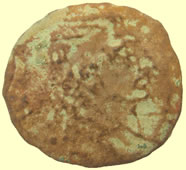
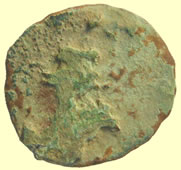
Roman bronze sent for ID - 25.23mm, 5.48g Another damaged, fragmentary and probably mineral-leached As. This one appears to be Antoninus Pius again- 138-161 AD - and the reverse has a standing figure, if you know which way to align it. I believe the standing figure of which we see the middle of the torso is Antoninus himself, togate, and sacrificing over an altar which is not quite visible to the left of the "S" from the S - C in the fields.
If it's the type I think it is, it dates to 148 AD.
|
|
|
|
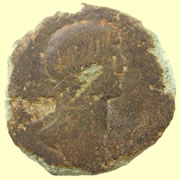
Roman copper coin with good bust outline- 4.78g,25.46mm Sent for ID The size indicates an As or a Dupondius - a Dupondius, however, like a Sestertius, would have been made of "orichalcum" - a naturally-occuring and not-necessarily consistent form of brass. The Romans did not recognize zinc as a separate metal and lacked the technology necessary to make brass from elemental copper and zinc in controlled proportions even if they had been aware of zinc. Orichalcum, like brass in general, tends to do better under wet and otherwise corrosive conditions than copper. Asses, however, were made from nearly pure copper. The weight of this specimen is way outside of the standard deviation - way too light even for the underweight local copies of Imperial Roman coins. It has obviously lost in the vicinity of half of its original weight to corrosion and/or mineral leaching.
I can't be certain whether it was originally an officially issued, or a contemporary copy of an Imperial As, but the portrait seems to be of Antoninus Pius. I doubt it could be anyone else, since his short beard can appear like a bare chin. Imperial beards came into style with Hadrian and all emperors after that time were bearded, right up through the time that copper Asses became very scarce and went out of use in the early-mid 3rd century - usually all had beards long enough not to be mistaken for a bare chin but Pius is shown with his beard very short. The shape of the head is just not right for Trajan or any of the Flavians, nor is the style right for any of the clean-shaven Julio-Claudians.
Mark
|
|
|
|
Huge Roman bronze, just sent it off for ID 32.57mm, 14.43g It's smallish, weight-wise, for this, but the diameter is in the right range for it - I'm pretty sure it's a Sestertius of Trajan.
Or, let me put it this way - I'm sure it's Trajan (98-117 AD), but there is some room for questioning the denomination, since as a Sestertius it should weigh in the vicinity of 20+gm.
14gm is a bit on the heavy side (but not completely out of the question) for an As or Dupondius, but the diameter is really too large for either. Also, on a Dupondius the bust would have a radiate crown - this specimen has a laurel-wreath. Asses tend to be a bit lighter than Dupondii, hence it's even less likely to be an As, but it "works" best as a lightweight Sestertius.
Mark
|
|
|
|
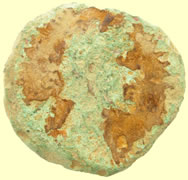
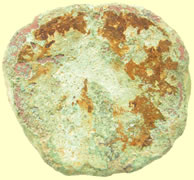
Roman 1st C bronze sent off for ID 21.64g, 33.15mm From the size and weight, it's a sestertius. From the outline and what I think I make of the letter-seriphs, it's Antoninus Pius. I can't really say much more about it with no reverse visible and none of the obverse legend clearly readable.
Mark
|
|
|
|
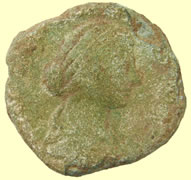
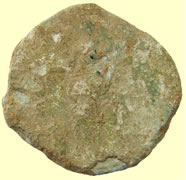
Large 1st C Roman bronze 14.70g, 31.62mm sent for ID This appears to be a Sestertius of Faustina II - wife of Marcus Aurelius (161-180 AD) She died in 175 and most of her coins are either posthumous or were issued while M. Aurelius was still Caesar under Antoninus Pius (139-161) so the dating can only be general with no reverse type to guide us and not enough obverse legend to tell if it's a life time or posthumous issue. There isn't much else I can say in the condition this one is in.
Mark
|
|
2ndC Roman bronze sent for ID 29.98mm, 13.8g This is a "DE GERMANIS" sestertius of one of the Aurelian emperors - I know these were struck for Commodus, very probably for Marcus Aurelius and maybe even for Lucius Verus - although the victory over the Germans of which this speaks may well have been after Verus' demise. |
|
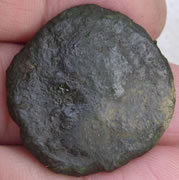 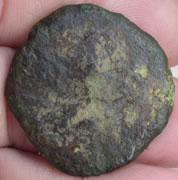
|
|
1st/2nd C Roman bronze sent for ID ,20.45g, 32.29mm This one can only be a sestertius - the big brass quarter-piece of the silver denarius - and most likely from the 2nd century AD. There isn't much more I can tell you, however, with no readable legends (readable by me, at least - are there any fairly clear letters around 1:00-2:00 on the obverse? It looks like there might be something there, but I can't be sure from your picture, even when I enhance the contrast.)
Working strictly from the silhouette, which appears to show a bun on the back of the head, it would seem likely to be one of the later Antonine wives - who mostly were portrayed with that sort of hairstyle - Faustina II, wife of Marcus Aurelius, Lucilla, wife of Lucius Verus, or Crispina, wife of Commodus - if it's one of these three, it dates to the 2nd half of the 2nd century. If, however, that's not a bun, just a raised area of corrosion, and if I had to guess at a male silhouette, I'd say either Trajan or Antoninus Pius, putting it in the 1st half of the 2nd century.
I'm afraid there's not enough detail on the reverse for me to hazard a guess at the reverse type - the 2nd century was famous for the huge variety of its reverse types - even if I were sure of the ruler, there could be dozens - in some cases, hundreds - of possible reverses.
Mark
|
|
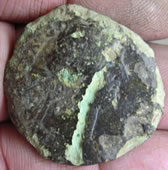 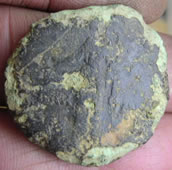
|
|
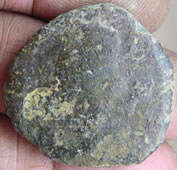
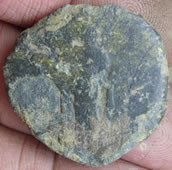
1st/2ndC Roman bronze 147 AD Now, I'm guessing at the size and weight based on your fingers in the picture - some metrology might be helpful - this is approximately 27-30mm diameter - or the coin originally was that size before all the edge-chipping occurred. We have a bit of legend at 10:30 obverse, - unfortunately it's a rather less than revelatory 'AVG', but knowing that AVG appears in the obverse legend at or near the mid-point might be very important in the deductive process. Next, we have the standing deity or personification on the reverse, but more importantly, we have the fairly unusual occurrence of a legend written horizontally across the fields.
From the portrait, My first guess was Hadrian, but I found no across-the-field reverse legends for him which fit with the relatively few of his obverse legends having AVG in the middle.
Antoninus Pius, however, has a sestertius with obverse legend ANTONINVS AVG PIVS P P TR P and PAX - AVG (a plausible reading of your coin's field-legend) across the reverse field - COS III S - C - Pax standing left, setting fire to a heap of arms and holding a cornucopia. Unfortunate there is so little design left to show the heap of arms, this is a rather ambitious coin-reverse. Your coin seems a bit skimpy for a sestertius, and without measurements, was initially tempted to say it's an As - however, no As with this type is known for Antoninus. Of course, I suppose that a coin that started out on the smaller side and then was mumbled about in the field by plows, etc, resulting in several visible generations of edge chipping could easily be reduced to this size.
So, my best guess is Antoninus Pius, Mint of Rome, 147 A.D. Brass sestertius. PAX AVG COS IIII SC - RIC III 777, SR 4201.
|
|
|
|
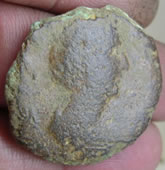
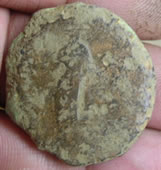
1st/2ndC Roman bronze sent for ID So, my best guess is Antoninus Pius, Mint of Rome, 147 A.D. Brass sestertius. PAX AVG COS IIII SC - RIC III 777, SR 4201. |
|
|
|
Huge 1stC Roman bronze "c. 150-160 A.D." 15.28g, 30.10mm x 4.25mm thick As you
say, there's little other than the main types for us to go on here,
but my best guess is that it's Faustina I or Sr. (depends on who you
read whether she's numbered or given seniority) |
|
|
|
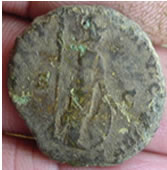
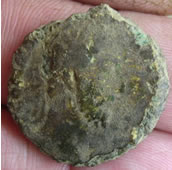
Commodus 184 A.D 'is
an As of Commodus. This son of Marcus Aurelius was a fairly crazy
bad guy who should never have been emperor, but wasn't probably
quite the craven wacko that Joaquin Phoenix portrayed him as in
the colorful but wildly historically inaccurate "Gladiator"
- for one thing, he certainly didn't kill his father to become emperor
- he had been co-emperor since 177 A.D. - 3 years before Aurelius'
demiseCommodus did, in fact, appear in the arena in his later life
- slaughtering wild beasts - and apparently thought he was Hercules
re-incarnate.The obverse reads (or should) : M COMMODVS ANTON AVG
PIVS. Laureate head right. - 23.64mm
|
|
|
|
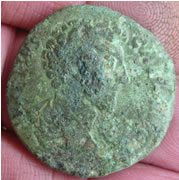
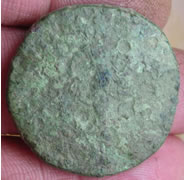
Another huge thick 1stC Roman in amazing shape - sent to Mark for ID 19.24g, 30.75mm dia 4.22mm thick Commodus is one of those "Royal Brats", who, like Caracalla, had a progression of realistic portraiture on his coinage - everything from a baby-book portrait to a brutally frank, "mature" image of a madman, just before his death at the ripe old age of 29. Caracalla looks every bit the cruel, brother-murdering, dissipate despot in his final coin portraits. Commodus' portrait-artists were a little kinder towards the end of his rule, but only slightly - this, however, isn't really the point today - just cited to let you know that on some Roman coins, not only are the portraits so realistic as to have you recognizing Hadrian's or Septimius Severus' look-alikes on the street today, but some of the longer-lived emperors who began their careers as child-Caesars can nearly be dated at a glance from the progression of the portrait - not unlike recognizing cars' model-years in the 1950's by the cut of this year's tailfin... Oh dear, I'm showing my age - and beginning to wander ( ;<{D}. At any
rate, and returning to the coin at hand, so to speak, this is Commodus
at the age of 22 or 23, in 183-4 A.D.. He was born in 161 A.D. the same
year his father - Marcus Aurelius - succeeded Antoninus Pius after a
very long term as Caesar himself. Commodus' first, baby-faced coin-portraits
appear when he is only 12. Sestertius,
Mint of Rome, 183-184 A.D. |
|
|
|
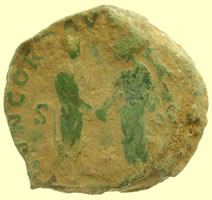
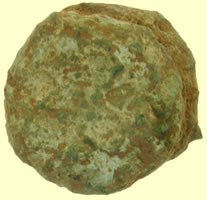
| Great find, 2 - 2ndC Roman bronzes stuck together Quite a mess - interesting, however. The reverse places and dates at least that one coin quite well. That's the "Concord Augustor" reverse showing Marcus Aurelius and his son-in-law and co-emperor Lucius Verus clasping hands. This was probably meant to instill faith in the two-emperor setup and/or Lucius Verus who was rather well known for his epicurean excesses. David Sear puts the situation this way: "...Verus...was the son of Aelius Caesar (Hadrian's chosen successor who pre-deceased him) In 138 he was adopted by Antoninus, but unlike M. Aurelius... adopted at the same time, he was not raised to the rank of Caesar. Nevertheless, on the accession of Aurelius in 161 AD, Verus was immediately made co-emperor. He was also ...[married] to Aurelius' daughter Lucilla in 164 AD. He campaigned in the East from 163-5 with considerable success, but he was a weak man addicted to pleasure and his death in 169 was a relief to his partner." In 161 when Antoninus Pius died and the then middle-aged Marcus Aurelius Caesar became Augustus this reverse was struck on all the Æ denominations (and most of the AR & AV denominations as well) of both emperors. Marcus Aurelius had actually been Caesar under Antoninus Pius for a little longer than he was to be emperor in his own right. The Concord Augustor reverse on a sestertius: http://www.stoa.org/gallery/album94/M_Aurel_2 Mark |
|
|
|
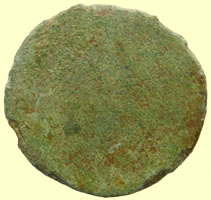
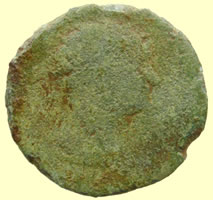
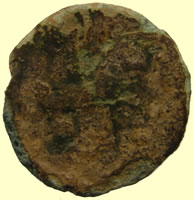
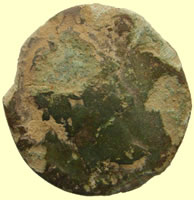
| Large Roman As sized coin sent for ID On the basis of first glance at the head portion of the bust, I'd have said a Flavian - Vespasian, Titus, young Domitian, all were portrayed with the chipmunk-cheeks, but also with a short, bull-like neck. This portrait has a long neck - rather like the portrait of Claudius - whose face is nothing at all like this face. I'm going to say that I believe the apparent shape of the face and head is probably distorted by corrosion and encrustation, and if one pulls the nose back a bit and deflates the apparently swollen cheeks, it begins to look a lot like Trajan - 96-117 AD. Mark |
|
  |
|
1stC Roman sent for ID I feel comfortable identifying this piece as Antoninus Pius - 138-161 AD. However, I really can't figure out what's supposed to be happening on the reverse - perhaps an equestrian scene? Mark |
|
|
|
This one gave us "a lucky break" - literally - the break in the legend was a major bit of luck here. The only really clear letters in the obverse legend are "...CAE - SAR..." to the left and right at the top of the obverse. This is a really unusual circumstance - mostly if a sestertius' legends were broken at all at the top (rather than running continuously around the upper circumference) they generally broke between words - "HADRIANVS - AVGVSTVS" for example. That the word CAESAR was so prominently in the middle of the legend (and therefore the title) and also broken in an unusual, even awkward, place, meant that I could look for this among the coins of a couple of emperors during the time they were "heir apparent" Caesars under their usually adoptive paternal emperors. I believe I have an exact match here - although the crucial legend-break is a bit less visible on mine, but take my word that it breaks "...CAE - SAR..." at the top - http://www.stoa.org/gallery/album93/17_A_Pius_Sest_Pietas Antoninus Pius during his very brief period of being Hadrian's Caear and heir - in the short window of time, a few months in 138 AD. (February 25 - July 10) between the death of Aelius, Hadrian's intended successor, and Hadrian's own demise. The full obverse legend would be then: IMP T AELIVS CAE - SAR ANTONINVS - the apparent shape of the head had me thinking Antoninus Pius from the beginning, so I wasn't all that surprised to find this legend break on a relatively common (for a brief issue) sestertius of his as Caesar. It also seems that the "voids" - the areas retaining some smooth brown patina on the reverse, correspond to the portions of the reverse field - complete to the E of PIE -TAS across the field falling directly above the small altar - protected by the relief of the figure of Pietas and the altar to her left. |
|
2ndC Roman bronze coin sent for ID The "sestertius" sized piece offers us less by way of positive markers, but the shape of the head (and the "corn-row" at the top of it) seems most like Julia Domna, wife of Septimius Severus. I can't figure what's happening on the reverse, but the chance that the orientation is based on whatever it is that looks like the letter "Y" is very unlikely. I'll try rotating the image a bit and see if it rings any bells. Here's an example of a sestertius of Domna, to show you what I'm talking about, re: the portrait sort of resembling her: http://www.stoa.org/gallery/Chaos-and-the/ML_10_Domna_Juno_sest
|
|
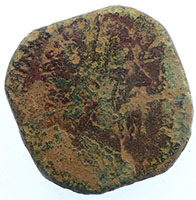
Huge Roman bronze sent for ID 29.22mm ,13.69g Without at least a bit of revelatory legend on the obverse (the "IMP..." at 8:00 isn't much help - nearly all the emperors from the 1st through the 3rd century began their official titles with "IMP") all I have to go on is the shape of the head and the general overall "fabric" of the piece. Being somewhat square, it belongs to the period in which "cob" style flan production had replaced the sphere-cast & hammer-flattened Æ blanks flans of earlier years. The earlier type of flan manufacture had produced a more nearly round product but was more labor-intensive and slower. Generally - although it is seen on-and-off for quite a while - the latter part of the 2nd and most of the 3rd century saw this form of blank production for the large Æ in which a round bar of coin metal approximately the desired diameter of the finished coins was cast, then individual blanks were chopped off the end with 3 or 4 heavy hammer and chisel strokes, on an anvil, rotating the bar 90º at a time between strikes. This tended to make squarish flans - like the one we see here. The vague standing deity or personification on the reverse doesn't show any attributes that might allow me to say who was intended - and the emperors of this period tended to use all the possible deities and personifications over time, so even if we knew who was on the reverse, it probably wouldn't be of any help identifing which emperor struck it. So, judging by the squarish flan and the shape of the head, I'd say this is most likely to be Severus Alexander, 222-235 AD. Here is a relatively unusual example struck on a large, "medallic" flan which doesn't show the results of cob manufacture nearly as clearly as some: Mark
|
|
2nd C Roman bronze coin - sent for ID 26.44mm, 8.17g My best guess is that this one is probably Hadrian (117-138 AD.) going strictly by the shape of the head. However, the reverse is going to be impossible to say much more than that it portrays a deity or personification standing to the right (? I think). This is getting close to the outer edges of identifiability - by photo at any rate. Mark
|
|
Monster sized Roman bronze sent for ID 32.23mm dia , 22.59g, 4.25 mm thick Although the detail you speak of doesn't really come through too well in the photo, I'm pretty certain this is Antoninus Pius (138-161 AD) and the reverse appears to be Securitas - that's just about the only personification ever shown slouching at her ease, leaning against a short pillar like this. I believe the reverse type and legend is SECVRITAS PVBLICA - S - C. Securitas standing left holding long, transverse scepter, resting left elbow on column. This would date to 142 AD if I have the type right. Probably RIC III 641 (or similar) Mark
|
|
2ndC Roman bronze coin sent for ID 32.53mm, 18.34g Trajan 96-117 AD. - I'm reasonably sure it is Trajan, but it's pretty tough to be certain in this case. Mark
|
|
2ndC Roman bronze coin sent for ID 8.31g ,25.89mm The woman is Faustina Sr., wife of Antoninus Pius. Coins were struck in her honor both while she lived and in an extensive series of posthumous issues both by Antoninus and Marcus Aurelius. Her coins, therefore, date to a broad period - 138 until 175, when her daughter, Faustina Jr, wife of Marcus Aurelius, died and her posthmous coinage completely replaced her mother's. Mark
|
|
2ndC Roman bronze coin sent for ID 17.93, 32.56 Hadrian - 117-138 AD. Unfortunately there isn't enough detail remaining to determine what reverse types of either of these may have been - which might allow us to date them more closely. Mark
|
|
Huge 2ndC Roman bronze coin sent for ID 18.15g,30.65mm You seem to have "lucked out" a bit with this one. It's Trajan (96-117 AD) and the bust style is appropriate for the later part of his reign. There's not very much of the reverse type visible, but here, as I said, you're in luck. This appears to be an example of the PROVIDENTIA AVGVSTII (SPQR S - C) type. It's the parallel lines in both the vertical & horizontal planes clearly indicating that there is a short pillar or column to the right of the somewhat slouching figure. On a later type, this would probably be Securitas leaning against the column, but at the time of Trajan's reign, Securitas or the personification of national security was not so much of an issue as it would become in a century or so when Securitas would replace Providentia (the personification of the forethought of the emperor in providing - well, whatever was provided at an Imperial level) in the same posture of ease. This type dates to 116 AD. Mark
|
|
19.75g,31.52 mm
This is a Sestertius (4 Asses) of Marcus Aurelius (161-180 AD) the reverse shows Salus, the personification of health (in the sense of wholeness or the health of the Empire as an entity) feeding a snake rising from the altar before her. This is a fairly common reverse type which recurs throughout the 1st-3rd centuries. Mark |
|
15.26g, 33.58mm A quick answer now and I'll get back to it in a while for a more detailed answer. At this size it would be a Sestertius, I don't immediately recognize the portrait, but I will get back to it later today. Mark
Big Roman 2ndC bronze sent for ID Trajan, 98-117 AD. Æ As
Big Roman bronze sent for ID 30mm, 14.65g This is actually a sestertius. It's too big and heavy to be a typical Antonine As (or Dupondius, which it obviously isn't, not being radiate) It's a much diminished sestertius, the edges significantly compromised by their time in the plow soil - hit by the plow repeatedly and weakened by exposure to agricultural chems. It's a sestertius of Antoninus Pius, 139-161 AD. He built one of the walls in the northland. The reverse type is not really without question at this time. I think the figure must almost certainly be Libertas / Liberalitas momentarily pausing while strolling down the street holding a liberty-cap / pileus and scepter. With none of the concentric legends providing any useful lettering, I can't be certain which of his several liberalitas events this might be linked to or the reverse legends this type was paired with (there were several). I'm afraid that's about all I can say on this one - too little surviving information to date it or place it with exactitude without making a truly all-out search effort. Mark
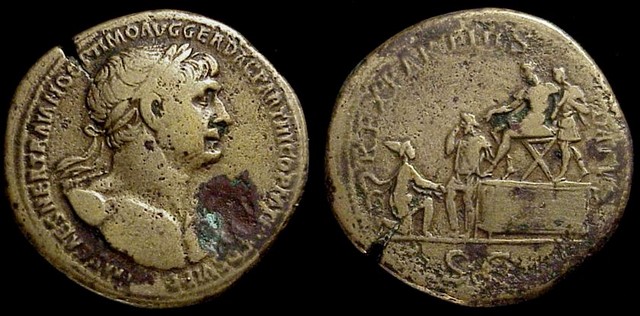
Big 1stC Roman bronze sent for ID At first I thought your coin was a Trajan sestertius with a "Platform Scene" reverse - somewhat like in the photo below: I think, from the shape of the head and the general silhouette, your specimen is pretty definitely Trajan - let me see if I have a photo of a Trajan platform scene...
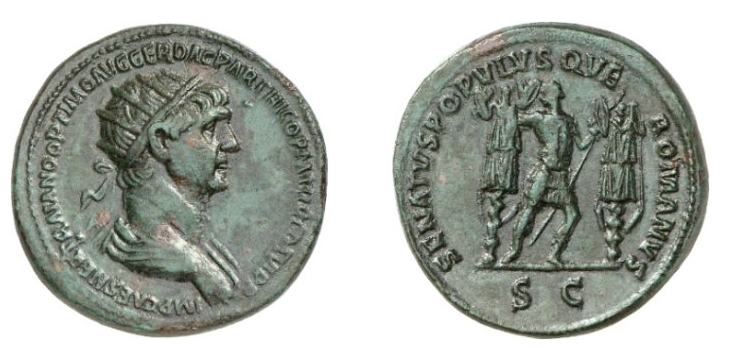
Trajan, 98-117 AD. I'm not saying this is a match for your coin - but at first I thought it was fairly close - Trajan had several platform scenes on his sestertii. Your coin seems to have a similarly long-winded list of titles in the obverse legend. Trajan had some of the longest legends/greatest numbers of letters in obverse legends ever to be strung around the circumference of a coin. I assembled this comparison photo which makes a pretty good case for Trajan on the obverse -
But as I look at the reverse more, I don't think this is a platform scene after all - I believe this would have for its legend SENATVS POPVLESQVE ROMANVS / SC - and the lower serifs of letters at ~ 2:00-4:00 reverse would fit with Romanus. There is a type on which Trajan is standing to right, head left, between two trophies - unfortunately, I don't have any photos of anything particularly similar, but if you look closely at the photo or the coin I think you can see how he's standing with his weight on the right leg, head turned to left, and there are 2 trophies, 1 each erected on his right and left. I will look for a photo of a coin with this reverse type and if I find one, I'll send it. Mark
I was unable to find quickly a photo of a sestertius with that reverse - in fact, I may need to say I think your piece is a dupondius, since it seems like no sestertius with that reverse type is listed. I'll admit I can't be certain that the portrait on your coin is not wearing the radiate crown of Sol which would be the identifying mark of denomination on the obverse.
This is what I thinik your coin might be - depending on size and whether we can make out a radiate crown. If it's large enough to be a sestertius and has a laurel-wreath portrait, that's something I'd need to ask an expert about - whether or not that particular type which is not in the RIC exists. Mark
Big Roman bronze sent for ID 22.9g, 33.13mm Yes, this has a bit of remaining detail – However, it’s going to need a bit of additional TLC if it’s to be identified beyond the basic generalities: Antoninus Pius was emperor during what is almost universally considered the height of “The Golden Age of Rome”
2nd C Roman bronze coin
Large 2nd C Roman coin sent for ID 8.86g,27.62mm Appropriate to yesterday (April 26th was Aurelius’ birthday) your “Big Roman 2” is an as of Marcus Aurelius (Augustus, 161-180 AD) Mark
Large 2nd C Roman coin sent for ID 27.17mm, 8.864g Now the piece you call “Big Roman 3” is also an as, but there is even less I can be certain about since the condition is so rough. I can’t make anything out of the reverse devices, perhaps I’m seeing “CO[M?]” around 11:00 - 12:00 in this orientation – or what I’m seeing as an “O” might be a figure’s head?
Very unusual 5 mm thick Roman coin sent for ID 7.66g, 19.48 dia, 4.86mm thick This is, I believe, a pretty uncommon find in British soil.
2ndC Roman bronze coin
Size and weight comparison of two large 2ndC Roman bronze coins
Roman bronze sent for ID 9.93g,29mm
Roman bronze sent for ID 18.68g, 32mm The “better” one – with green in the fields, is a Domitian (81-96 AD) Sestertius – I’m assuming the denomination/diameter based on the size-ratio between the letters and the rest of the devices.
Big Roman with partial legend sent for ID I’m afraid I’m not going to be able to give you a really specific ID here – I’m afraid the fragments of obverse legend are of the wrong parts of said legend and the name of emperor is gone. The portrait is similarly roached, but on the basis of what is visible I’d say chances are pretty good this is either Trajan or Hadrian. The reverse type (rotate the reverse image about 30º counter-clockwise so the “S” in the field comes upright) is almost certainly Pietas. That both-arms-raised pose is just about exclusive to representations of Pietas. What we’re not seeing is that she’s probably sprinkling incense over a small lit altar. Another possibility for the personification on the reverse might be Annona, as on this as of Hadrian: http://old.stoa.org/gallery/album92/ML08_Hadrian_Annona_as?full=1
Big Roman bronze sent for ID
18.8g,32.9mm It’s Roman it’s a sestertius at ~ 19g and 33mm Mark
Interesting obverse on this big Roman bronze - sent for ID It was actually pretty easy – and this is a fairly scarce and desirable type. |
|
|
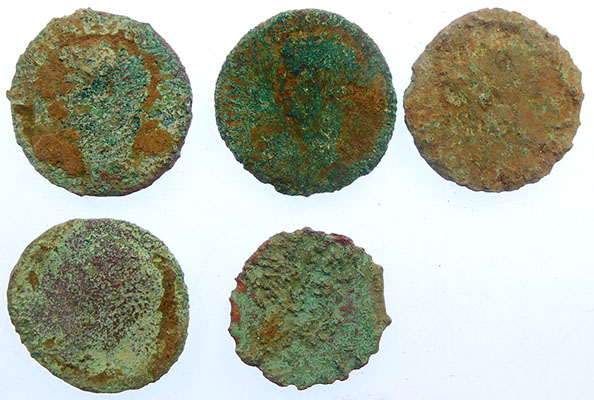
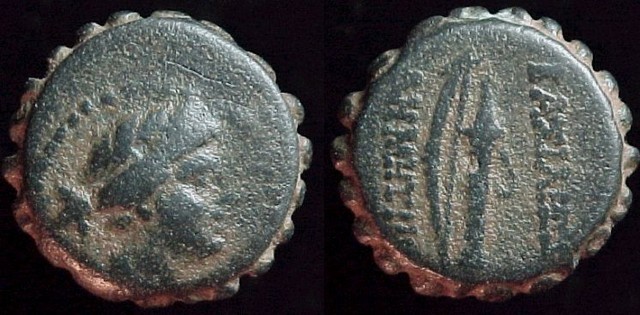
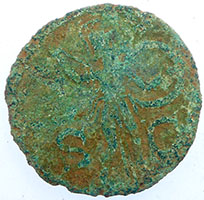
Roman grots off new field in your "grots" photo, the first two also appear to be Claudius asses. I can't make out enough on the 3rd or 4th to venture any guesses, but the seemingly serrated 5th piece is interesting. I don't know of any Roman AE's of the period of Roman Britain which were created as serrati. (there were a number of Roman "serrati", but all were early B.C. AR Republican denarii - with similar edges)
A Seleukid serratus
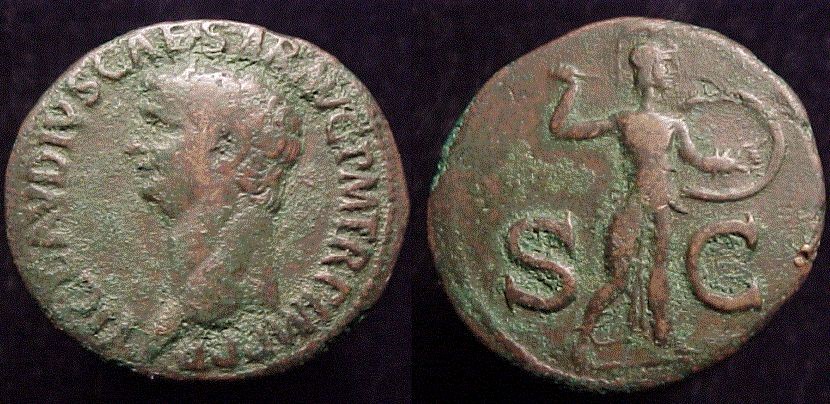
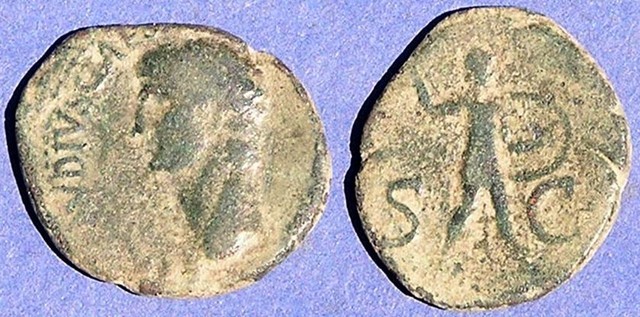
Very interesting big Roman bronze sent off for ID 7.38g, 26.13mm The big one is a Claudius as - anepigraphic reverse with Minerva holding shield and brandishing spear: Top picture is a smallish, underweight (but surprisingly common) British copy of the type - lower photo is an "official" Rome mint specimen
This is the British copy
Mark
Another interesting big Roman bronze sent off for ID This one is more of a challenge, from the weight and diameter, it seems like a fairly early as - I can't really make out anything on the reverse (a bent leg?, that's about it) but the obverse looks like a female bust right with hair in bun at nape. Faustina Jr. immediately comes to mind, but could be Lucilla or Crispina - or perhaps someone more obscure. The few letters of legend on the obverse are tantalizing, but I can't make any sense out of the apparent legend fragment.
Beauty big Roman with detail - sent off to Mark Lehman for ID Hadrian (117-138 A.D.) Æ As, Mint of Rome, Struck AD 119-121 large shield to right; S-C across fields; BRITANNIA in exergue
Very unusual monster thick Roman bronze - sent for ID Huge thick sucker !! 23.189g, 4.76mm Thick x 28.11 Wide. This one will be a bit harder to give you the sort of detail I did with the Hadrian as I believe this is a match - if not, it's close - I can't read any of the reverse legend. It's very similar, quite possibly the same, but he issued the same few types year after year changing only the dates, so my dating may be off.
2nd Roman bronze coin - sent for ID Antoninus Pius, (138-161 AD.) Brass sestertius - Female deity or allegorical personification standing facing, head left, holding uncertain objects – and again, too little legend and detail to be sure, but it m,ight be a globe and scepter that she’s holding 13.3g, 26.31mm |
|
Big Roman copper coin sent for ID Not too sure what I can say about this one and not be completely guessing.
2ndC Roman bronze coin
2nd C Roman bronze coin sent for ID Antoninus Pius 138-161 AD I'm afraid I can't add much, there's too little detail. It's still Antoninus Pius, the reverse has S - C in fields and a standing personification or deity, too damaged to say who - concentric legend, only hits of it visible COS III is a common reverse legend for Pius who struck multiple dozens of types of asses, so anything more I were to try to tell you would be strictly conjecture.
|
|
| |
|

|
|