Metal detecting holidays in England with the World's most successful metal detecting club.
Twinned with Midwest Historical Research Society USA
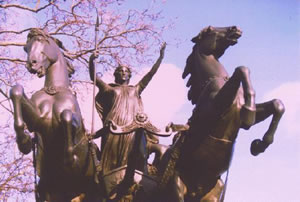
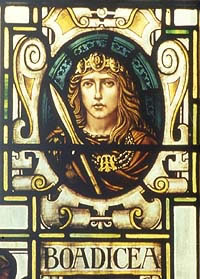
Boudicca (Boadicea) (AD 62)
|
|
Boudicca is one of Britain’s
greatest heroines, a freedom fighter who rebelled against the Roman
government. Her rebellion was the only viable challenge to the supremacy
of the Romans who, until the fifth century, exercised a distinct influence
over Britain and its heritage. Despite the fact that it
took place almost 2000 years ago evidence of this mighty rebellion can
still be found; from the remains of an Iceni settlement on the outskirts
of Thetford to the Snettisham Hoard on show at Norwich Castle Museum. Great British Queen of ancient
Britain, married to Prasutagus and with him she ruled over the Iceni
- the tribe occupying East Anglia - but under Roman authority. Like
many other rulers in Britain at this time, Boudicca witnessed the suffering
caused to her people by the heavy taxes, conscription and other indignities
generated by the Roman Emperor Nero. The final outrage came when her
husband Prasutagus died, and the Romans plundered her chief tribesmen
and brutally annexed her dominions. This was too much for the Queen
and she determined to take on Nero and his Legions. In this she was
not alone, for tradition tells that all of south east Britain came to
her side, ready to die for the Queen who was fierce enough to take on
the Roman Empire. It's noteworthy that tribes which remained loyal to
the Romans, (like the Catuvellauni) were not spared Boudicca's wrath.
Boudicca's opportunity came when the Roman Governor General Seutonius Paulinus and his troops were stationed in Anglesey and North Wales. By the time Paulinus got back, the Roman municipalities of St Albans and Colchester had been burned to the ground by the Britons. Boudicca's warriors were more than a little intimidating. They virtually routed the Ninth Legion that had been marching from Lincoln to help Paulinus, and without additional support from Rome there was little he could do against the determination of these people.
Many thousands of Britons fell in battle and those who lived were hunted down by Roman soldiers. But it would seem that Boudicca's actions had shocked the Roman world into adopting policies that were a little kinder. Some historians believe that the relative lack of Romano-British remains in Norfolk is testimony to the severity with which the Roman Empire crushed Boudicca and the Iceni peoples. Finally, faced with defeat, the proud warrior Queen took her own life, by drinking from a poisoned chalice. This much is well known; the challenge is to separate fact from the many legends. For instance, is she really buried under Platform 10 at London's King's Cross Station? We'll probably never know, because for centuries people have been claiming their own local sites as her final resting place.
|
 Eventually
they marched on London and it was here at last that Paulinus faced Boudicca
and her army of Britons in the field. We don't know where, (possibly
the Midlands) but we do know that a desperate battle was fought, and
although the Romans were the victors, they regained the province at
great price.
Eventually
they marched on London and it was here at last that Paulinus faced Boudicca
and her army of Britons in the field. We don't know where, (possibly
the Midlands) but we do know that a desperate battle was fought, and
although the Romans were the victors, they regained the province at
great price.